posted Tuesday, 09 June 2009, 22:20 (+0800), by Martin

Phottix Plato
Intro
The Phottix Plato is another wireless shutter release for digital SLR cameras, and was released in October 2008 at Photokina. The Plato has some interesting new features, including bi-directional 2.4GHz communication, and uses commonly-available AAA batteries.
If you're not interested in reading the details of this review, you can jump straight to my conclusions.
Thanks to HK Supplies for providing a Plato C8 for review purposes.
Overview of the Plato
As with other wireless shutter releases, the Plato has two primary components, namely the receiver and the transmitter. As with the other Phottix accessories I've reviewed, the actual model name (ie, "Plato") does not appear on either the transmitter or receiver, but only the company name "Phottix" appears on the front of both, and the model number "WXD-188" appears on the back of both.
The receiver needs to be connected to the camera's remote shutter release connector via a cable supplied with the Plato. Rather than having a cable hard-wired into the receiver, the receiver has a 3.5mm stereo socket, and different Plato models come with cables to suit different cameras.

Plato receiver
The base of the receiver has a plastic shoe, which allows the receiver to be mounted on the hot-shoe of a camera body. Note that this is purely for convenience - there are no electrical contacts in the plastic shoe on the receiver.
The Plato transmitter is a little larger than the Cleon and Cleon II transmitters, and is much more rectangular. The larger size is primarily due to the fact that the Plato transmitter uses two AAA batteries rather than the small 23A battery used in the Cleon and Cleon II transmitters. However, it's still a compact unit, and fits easily into my camera bag.
The Plato receiver is marginally larger than the Cleon and Cleon II receivers, and this is again due to the use of larger batteries, ie, 2 AAA batteries rather than the much smaller 23A battery.
Four AAA batteries are provided in the Plato packaging. I received four Toshiba super heavy duty batteries with my Plato.
Neither the transmitter nor the receiver has an external antenna.

components: handstrap, 4x AAA batteries, receiver, transmitter and camera cable
One feature that sets the Plato apart from most other wireless shutter releases is the bi-directional communications it provides. Using 2.4GHz RF communications, the transmitter provides instant feedback from the receiver via a second status LED, providing confirmation that the transmitter is successfully communicating with the receiver.
Cleon Models and Camera Compatibility
All DSLR camera manufacturers use different connectors for connecting shutter releases to the camera, and Phottix provide several different models of the Cleon, to suit different cameras. The only difference between these models is the connector on the end of the cable that's hard-wired into the receiver.
The complete lineup of Phottix Plato models is as follows:
- C6: for Canon 300D/350D/400D/450D/1000D, Pentax K20D/K200D/K10D/K100D, Samsung GX-1S/GX-1L/GX-10/GX-20
- C8: for Canon 10D/20D/30D/40D/50D/5D/1D
- N6: for Nikon D70s/D80
- N8: for Nikon D100/D200/D300/D700/D3, Fuji S3Pro/S5Pro, Kodak DSC-14N
- N10: for Nikon D90
- S6: for Sony A100/A200/A300/A350/A700/A900, Minolta Dynax 7D/5D/Dynax 3/4/5/7, Dynax 505si/600si/700si/800si/807si
- O6: for Olympus E400/E410/E420/E510/E520, SP-510UZ/SP-550UZ/SP-560UZ/SP-570UZ
- P6: for Panasonic DMC
Features and Specifications
Features (as listed on the packaging):
Uses the 2.43GHz worldwide frequency. It has less restriction for worldwide use.
It is more stable, faster, and takes less power.
2.43GHz has high resistance to interference for a secure transmit range,
even in crowded environment, range up to 100 meters.
Smart code technology (codes pre-set in production): 16,000,000 combinations of safe codes, highly resistant to interference.
Transmitter and receiver will automatically turn off after one hour of non-usage.
Optional cables for different kind of cameras.
Uses easily found, low cost AAA batteries for both.
Specifications (as listed on the packaging):
Smart code technology (codes pre-set in production): 16,000,000 combinations of safe codes, highly resistant to interference.
Transmitter and receiver will automatically turn off after one hour of non-usage.
Optional cables for different kind of cameras.
Uses easily found, low cost AAA batteries for both.
| Frequency | 2.43GHz |
| Communication | Two-way system |
| Working Voltage | 3V |
| Operation Current | <30mA |
| Standby Current | 10uA |
| Transmit Power | 1dBm |
| Transmitter power: | 2 AAA batteries |
| Receiver power | 2 AAA batteries |
Modes of Operation:
The Plato transmitter allows any of the following four modes to be selected:
- S - single shooting mode, with a single photo being taken when the transmitter shutter button is depressed
- 2S - adds a 2 second delay before the camera shutter is triggered
- Multiple Exposure - causes 5 photos to be taken quick succession
- B - bulb mode, with a single press of the transmitter shutter button opening the camera's shutter, and another press closing it again
All four modes can be used with the Plato operating in wireless mode (with the receiver connected to the camera via the supplied cable), or in wired mode (with the transmitter connected to the cable via the supplied cable).
Power Saving:
Both the Plato transmitter and receiver will automatically turn themselves off after one hour of idle time. A power saving feature such as this is always useful to preserve your batteries if you forget to turn the units off.
However, it could be annoying if you are triggering a remotely mounted camera with a Plato receiver, and more than an hour elapses between successive actuations.
Synchronising the Transmitter and Receiver
The Plato supports 16,000,000 different channels, with the channel being preset in the transmitter in the factory. Once the receiver has been synchronised with the transmitter, there should be no need to re-synchronise it, and it'll retain it's synchronisation information even if the batteries are removed.
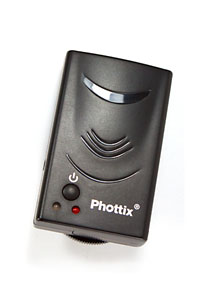
receiver
|

transmitter
|
To check if the transmitter and receiver are synchronised, turn on the receiver by holding down the power button on the receiver for approximately three seconds, and right LED on the receiver should start flashing red slowly. Turn on the transmitter by holding down the set/power button for approximately three seconds, and the mode LEDs should all briefly light up, and then the "S" LED should remain on.
Press the shutter button half-way down on the transmitter, and the left LED on the receiver should go green. Fully depress the shutter button on the transmitter, and the left LED on the receiver should go red briefly.
If the left LED on the receiver doesn't respond to the transmitter's shutter button, then you'll need to synchronise them using the procedure described below.
To synchronise the receiver to the transmitter:
- turn receiver on by holding down power button for ~3 seconds until the right red LED flashes
- press power button on receiver 5 times left LED flashes red fast
- turn transmitter on (by holding down set/power button for ~3 seconds until mode light turns on)
- press shutter button on transmitter
- left LED on the receiver should turn off
Note that multiple receivers can be programmed to respond to a single transmitter, allowing you to trigger multiple cameras with a single transmitter.
Using the Plato as a Wired Shutter Release
The Plato can be used as a wired shutter release, by connecting the supplied camera cable to the Plato transmitter. Once the transmitter is turned on, and an appropriate mode selected, the shutter button on the transmitter can then be used to trigger the camera's shutter.

Plato transmitter connected for wired operation
A half-press of the transmitter's button is equivalent to a half-press on the camera's shutter button, and a full press is equivalent to a full press on the camera's shutter button.
Note that the Plato transmitter can only be used as a wired remote if the transmitter has batteries installed, and is powered on. This is quite different from the Cleon and the Cleon II, where the receiver can be used as a wired remote, but doesn't require any batteries.
Using the Plato Wirelessly
To use the Plato wirelessly, the receiver must be connected to the camera's remote socket via the supplied cable. The Plato receiver has a plastic shoe, and can optionally be inserted into the camera's hotshoe.
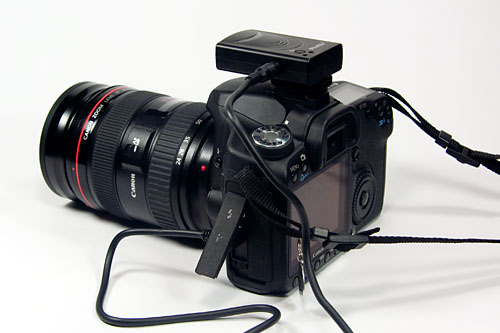
Plato receiver mounted on a Canon 50D
Power the receiver on by holding down its power button for ~3 seconds, until the right LED starts flashing red slowly.
The transmitter, once powered on, can then be used to trigger the camera's shutter remotely. The Plato specifications claim a range of 100m, but I haven't yet tested the range.
The Plato transmitter has two status LEDs at the top right, labelled "1" and "2". The left LED (labelled "1") indicates the status of the transmitter, with green indicating a half-press, and red indicating a full press of the transmitter's shutter button.

Plato transmitter
The right LED (labelled "2") indicates the status of the remote receiver, and uses the bi-directional communications between the transmitter and receiver to obtain this information. Green indicates the receiver is performing the equivalent of a half-press on the camera's shutter button, and red indicates it's performing the equivalent of a full press of the camera's shutter button.
The "2" LED on the transmitter provides instant feedback that there is effective communications between the Plato transmitter and receiver.
Comparing the Plato with the Cleon and Cleon II
Here's a summary of the differences between the Phottix Cleon, Cleon II, and Plato wireless shutter releases, as published by Phottix:
| Cleon | Cleon II | Plato | |
| Frequency | 315MHz | 433MHz | 2.4GHz |
| Channel | 16 channels | smart code (16,000,000) | smart code (16,000,000) |
| Battery | 23A and CR2 | 23A and CR2 | 2 AAA |
| Single / 2S / Continuous | by receiver | by transmitter | by transmitter |
| Cable | fixed | optional | optional |
| Transmission | one way | one way | two ways to confirm in range |
| Range | 50-100m | confirmed 100m and more | confirmed 100m and more |
| Resistance to Interference | Normal | High | Extremely High |
The Verdict
Strap Issues
This is actually the second Plato unit I received for review. While testing the first unit during a dawn photoshoot, I attempted to put my hand through the hand strap on the transmitter. I managed to just squeeze my hand through the strap, but when I tried to take it off my hand, the strap broke, causing the transmitter to fall about 1.5m onto a concrete path. After that fall, the transmitter would no longer turn on at all.
After communicating this to Phottix, they provided a replacement unit, with a stronger hand strap. While the strap does indeed look a little stronger, it's actually smaller, and there is no way I can get my hand through the strap.
No Lanyard on Receiver
There is no lanyard or strap on the receiver, and nor is there anywhere to attach one to the receiver (other than tying one around the plastic shoe).
In some situations, I find myself using a remote shutter release to trigger the camera shutter, but also have a flash mounted on the camera's hotshoe, or a wireless flash trigger (ie, when photographing water drops recently). Without any way to hang the Plato receiver from the tripod, the receiver ends up dangling on the end of the camera cable, which isn't ideal.
Uses Readily Available AAA Batteries
One of the biggest benefits of the Plato compared to other wireless remotes such as the Cleon and the Cleon II is that the Plato uses commonly available AAA batteries, rather than the 23A and CR2 batteries used in the Cleon and Cleon II. Because AAA batteries are much more readily available and cheaper, you are less likely to end up with flat batteries out in the field. Rechargeable AAA batteries can also be used in the Plato.
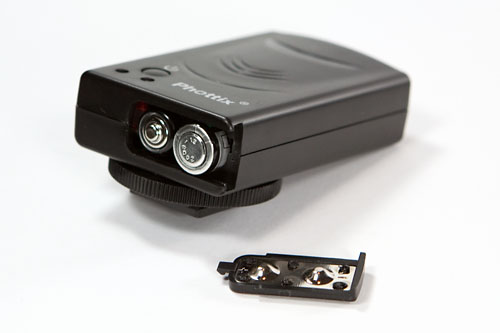
Plato receiver and transmitter take 2 AAA batteries each
Instant Feedback from Receiver
The bi-directional communications of the Plato is useful, as it provides an immediate indication via the status LEDs on the transmitter that it can successfully communicate with the remote receiver. This can be particularly useful if the camera and receiver are out of sight (or at least far enough away so you cannot see the LEDs on the receiver, or hear the camera shutter).
2.4GHz Communication
Phottix claim that the 2.4GHz RF communications used by the Plato is less likely to be affected by interference compared to the 315MHz used by the Cleon, and the 433MHz used by the Cleon II.
Higher frequencies are typically better for longer distances, but I wonder how much the Plato will be affected by 2.4GHz 802.11b/g wireless networks and cordless phones.
I haven't yet had a chance to compare the range of the Plato with that of the Cleon and Cleon II. However, I intend to do so in the near future, and will be writing about the results of such a test on my blog.
(Although neither the Plato transmitter nor receiver have an external antenna, I am tempted to try modifying a Plato with an external antenna, as I've had some experience making and modifying 2.4GHz antennas.)
Cost
The Phottix Plato is a little more expensive than the Cleon II, and typically sells for approximately AUD$65 (approx USD$51), although prices do vary.
However, if you want the ability to be able to use AAA batteries, and want the usefulness of bi-directional 2.4GHz communications, then the Plato is certainly worth the additional cost.
Update: Phottix are now selling the Plato via their recently launched their online store.


Thank you very much Martin. It is definitely useful and helpful review of Phottix Plato which I am really interested.
I feel I made a correct decision of buying Cleon II instead of Plato after reading this review. Although Plato has some good features like use AAA battery and its bi-directional 2.4GHz communications, I don't like the way of switch different shutter relase modes by depressing a button for long time to cycle, I'd prefer to use slide switch to easily and quickly change the release mode which Cleon and Cleon II offered. and, I personally also don't like the Wired Shutter Release method that Plato provided where need batteries installed. This is really NOT good by comparing with the Cleon and the Cleon II, where the receiver can be used as a wired remote, but doesn't require any batteries.
IMO, Cleon II is good enough for everybody in common use unless you are frequently shot in a crowdy scene that many peoply using wireless remote that cause you pay more attention to the frequency to avoid interference.